What New Construction in San Diego Means for You in 2026
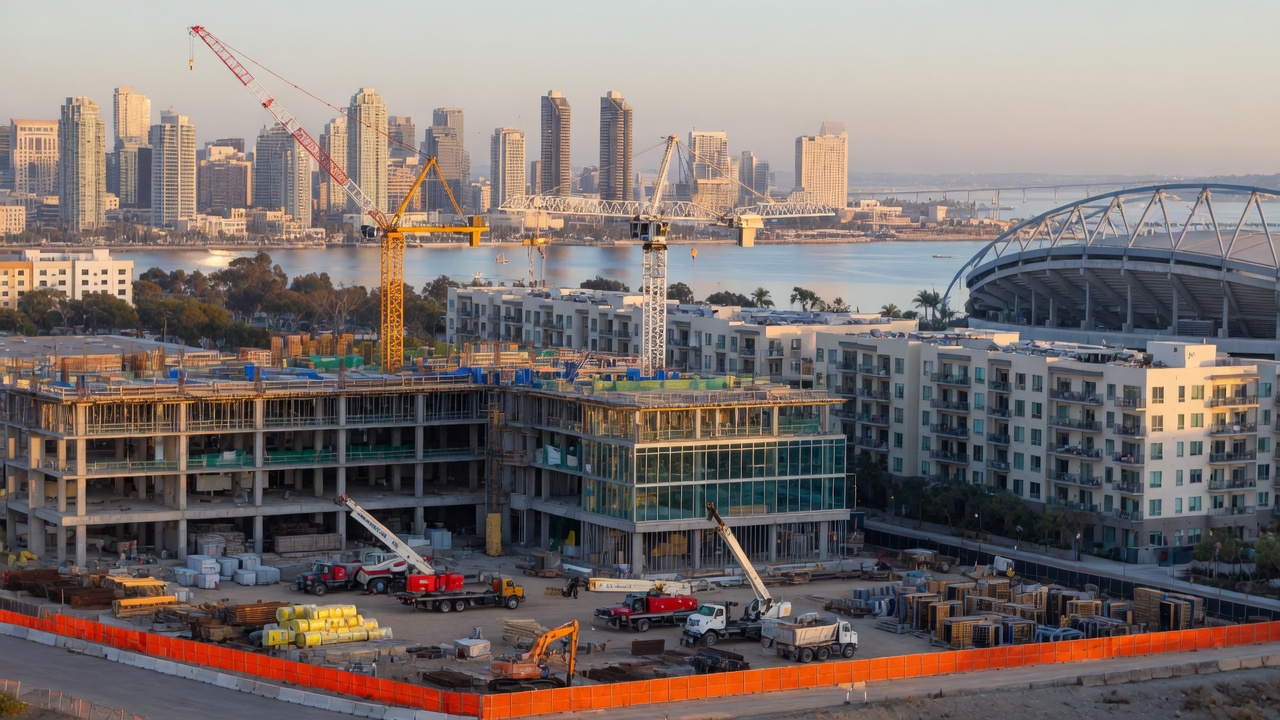
San Diego is in the middle of the most significant construction cycle it has seen in a generation. From a multibillion-dollar redevelopment of the Midway District to thousands of new homes rising in Mission Valley, Chula Vista, and beyond — the physical landscape of this city is changing in real time. And if you are buying, selling, or investing in San Diego right now, you need to understand what all of this new construction means for your bottom line.
With over 10+ years in real estate — and a background in commercial contracting before that — I watch construction the way a pilot watches weather. It shapes every flight plan, every decision, every outcome. What is being built, where it is going, how fast it is moving, and who it serves — these are not abstract questions. They are the questions that determine whether your home appreciates, whether your rental pencils out, and whether the neighborhood you are considering five years from now looks anything like it does today.
Here is where things stand as of mid-June 2026.
Midway Rising: The Largest Redevelopment in San Diego History
If there is one project every San Diegan should be paying attention to, it is Midway Rising. This is a multibillion-dollar redevelopment of the city's former sports arena site in the Midway District, and at full buildout, it will include over 4,200 residential units — nearly half of them affordable — along with a new 16,000-seat arena, parks, retail, and open space.
As of June 16, 2026, the San Diego City Council has delayed its decision on the project's real estate deal. Developers still have until the end of December 2026 to finalize a long-term lease with the city, after which the Council must formally approve the agreement. The project has already received a key state-level confirmation that it can exceed the existing height restrictions along the sports arena site, clearing one of the most significant regulatory hurdles.
What does this mean if you own property in the Midway District, Point Loma, or the surrounding communities? Increased density, new infrastructure, and a dramatic transformation of a corridor that has been underbuilt for decades. In the near term, the uncertainty around the timeline creates a mixed signal — some buyers and sellers are pausing, waiting to see where things land. In my experience, the projects that face delays in approval are not the ones that disappear. They are the ones that eventually reshape the market. If you own in this area, having a strategy for both scenarios — construction proceeds on schedule and construction pushes to 2027 or 2028 — is critical.
SDSU Mission Valley: A New Neighborhood Taking Shape
Just east of the Midway District, the SDSU Mission Valley campus is quietly becoming one of the largest residential developments in San Diego. The master plan calls for up to 4,600 housing units at full buildout, alongside 80 acres of parks, 1.6 million square feet of research and innovation space, 95,000 square feet of retail, and a hotel.
The first residential phases are already underway. AvalonBay Communities broke ground in 2025 on a 621-unit market-rate development, and Chelsea Investment Corp. broke ground in May 2026 on the first affordable housing project at the site. First occupancy for these initial phases is projected in 2028, but the signal is clear: Mission Valley is adding thousands of homes in a neighborhood anchored by a major university, a professional soccer stadium, and planned transit connections.
For buyers, this matters because Mission Valley's existing condo and townhome inventory — particularly in communities like Civita — will face new competition as these units come online over the next two to three years. If you are looking at a townhome in Civita or along the Mission Valley corridor, understanding the full pipeline of what is coming is part of making a smart purchase. The Everly at Civita community by Toll Brothers, for example, offers luxury townhomes starting around $1.2 million to $1.7 million with resort-style amenities. These are strong products, but the neighborhood will look very different by 2030 than it does today.
Chula Vista and South County: Where the Growth Is
South San Diego has long been one of the most active development corridors in the county, and 2026 is no exception. In Otay Ranch, new communities like Anden are adding approximately 93 townhouses to a neighborhood that already has strong schools, family-oriented amenities, and relative affordability compared to coastal markets.
Meanwhile, the city recently approved the Collection at Cactus, a nearly 1,000-unit housing development near the U.S.-Mexico border that will add significant residential supply to southern San Diego. And the Chula Vista City Council approved an $80 million bond issuance in May 2026 for affordable housing at Otay Ranch, signaling the city's commitment to adding workforce housing alongside market-rate construction.
From an investment perspective, South County's development activity creates two dynamics worth watching. First, new inventory at various price points means more options for buyers who are priced out of coastal and central markets. Second, the infrastructure and commercial development that follows residential growth — schools, retail, transit — tends to lift property values in surrounding established neighborhoods. If you are evaluating investment properties in Chula Vista, National City, or southern San Diego, understanding the development timeline is as important as the cap rate.
The ADU Boom: San Diego's Backyard Revolution
Some of the most consequential construction in San Diego is not happening on large development sites — it is happening in backyards across the county. Accessory dwelling units, or ADUs, have exploded in San Diego, with city permits growing from 538 in 2024 to 1,122 in 2025 — more than doubling in a single year. Through the first two months of 2026 alone, over 240 permits were issued.
This is not a trend. It is a structural shift in how San Diego produces housing. Several policy changes have accelerated the movement:
- AB 1033 took effect in San Diego County on April 4, 2026, allowing ADUs in unincorporated areas to be sold as separate condominiums. This is a game-changer for homeowners who want to build an ADU and recoup their investment through a sale, and for buyers who want an entry-level homeownership option in established neighborhoods.
- SB 543, AB 1154, and AB 462 — effective January 1, 2026 — have streamlined ADU permitting by enforcing binding 60-day approval timelines and simplifying regulations in coastal and multifamily zones.
- San Diego's 2025 Land Development Code amendments now allow up to eight ADUs on some qualifying properties, dramatically expanding what is possible for homeowners with space.
As someone with a contracting background, I can tell you that the quality and design of ADUs matters enormously — not just for the homeowner, but for the neighborhood. A well-built ADU adds value, generates income, and serves the community. A poorly built one creates problems. If you are considering an ADU, either as a homeowner or as an investor evaluating a property that has one, understanding the construction quality, permitting compliance, and long-term maintenance requirements is essential. This is exactly the kind of analysis I bring to every investment conversation.
What This Means for Buyers
New construction creates opportunity. More housing supply — at multiple price points and in multiple neighborhoods — means more choices for buyers who have been competing for a limited pool of existing homes. Townhomes in Otay Ranch, condos near SDSU, modern ADUs in established neighborhoods — the product mix is expanding.
But new construction also introduces complexity. Construction timelines slip. Developer warranties vary in quality. Neighborhoods near active construction sites experience noise, dust, and traffic disruptions that can last years. And the long-term impact of increased density on schools, roads, and community character is not always straightforward.
If you are buying new construction, having an agent who can read a site plan, evaluate a developer's track record, and assess how a project will affect surrounding property values is not a luxury. It is a necessity. Our Buying Guide covers what to look for when evaluating both new construction and resale properties.
What This Means for Sellers
If you are selling an existing home near a major new development, the impact cuts both ways. On one hand, new construction brings attention to the area, improves infrastructure, and signals long-term investment in the neighborhood. On the other hand, your home will eventually be competing with brand-new inventory that carries modern finishes, builder warranties, and sometimes concession packages.
The sellers who succeed in this environment are the ones who position their homes strategically — emphasizing the advantages of established neighborhoods (mature landscaping, larger lots, no HOA in many cases, existing community ties) while pricing competitively against what new construction is offering. My Selling Guide walks through how to prepare and position your home for maximum impact.
What This Means for Investors
San Diego's construction pipeline creates both opportunity and risk for investors. New rental supply — particularly the apartment projects in Mission Valley and the multifamily developments across the county — is moderating rent growth. The city has already dropped to 12th most expensive rental market nationally, down from the top 10. For buy-and-hold investors, underwriting needs to be realistic about where rents are headed, not where they have been.
On the other hand, the ADU revolution opens doors that did not exist even two years ago. The ability to build an ADU and sell it as a separate condo under AB 1033 creates a new investment strategy: build, sell, and recoup your costs while adding to the housing supply. And for investors who understand construction, the gap between what it costs to build a quality ADU and what the finished product commands in the market can be significant.
This is the kind of analysis that benefits from a conversation, not a blog post. Every investment scenario is different, and the details matter. If you are evaluating your next deal, exploring ADU possibilities on a property you own, or simply want to understand how new development affects values in a specific neighborhood, I would love to help you think it through. Explore our Investment Properties page to see how we approach real estate as both agents and investors.
A Military Spouse Perspective on Growth
As a military spouse, I have watched San Diego grow and change through multiple duty stations, multiple market cycles, and more moves than I care to count. What I have learned is that the neighborhoods that grow best are the ones where the community pays attention — where residents understand what is being built, why it matters, and how to position themselves for what comes next.
San Diego's growth is not random. It follows infrastructure, employment, and policy. The Midway District is transforming because the city identified it as a priority redevelopment zone. Mission Valley is densifying because a university chose to build a campus there. South County is growing because the land exists, the demand is real, and the policy environment supports it. Understanding these patterns is the foundation of good real estate strategy — whether you are buying your first home, selling your family home, or building a portfolio.
For military families navigating a PCS move to San Diego, new construction is particularly relevant. You may be arriving to find that the neighborhood you researched two years ago looks different — newer, denser, with new schools and new amenities. That is not a problem. It is information. And the right agent helps you interpret it.
What is important to you as you think about your next move? Whether you are buying, selling, investing, or simply trying to understand what all of this construction means for the home you already own, the conversation starts with your goals and your timeline.
Where are you headed next? Let's talk about it. I bring 10+ years of market knowledge, a contractor's eye for construction quality, and a genuine commitment to making sure you have the information you need to make confident decisions. No pressure. No assumptions. Just honest guidance.
Ready to discuss what's happening in your neighborhood? Contact me directly or call 619-630-9618. I am here to help you navigate whatever comes next.

Hanna Bederson
Real Estate Agent, Investor & Military Spouse · San Diego · DRE #02096870
Curious how new development affects your property or investment?
Let's Talk StrategyIn service, Hanna