Riverwalk San Diego: Inside the $4 Billion Transformation of Mission Valley
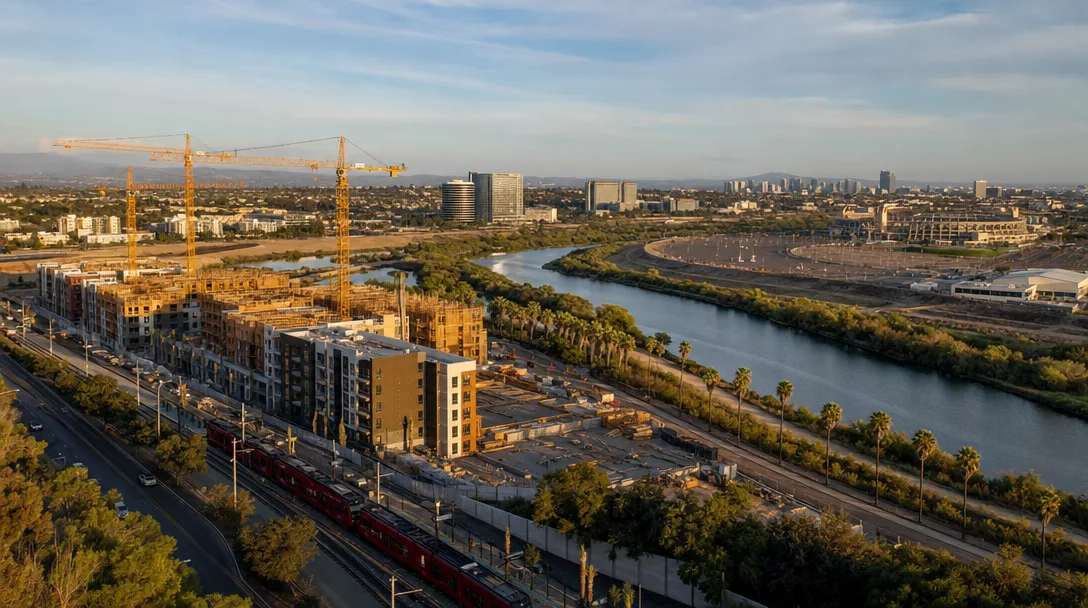
If you have driven through Mission Valley recently, you have seen the cranes. They line the San Diego River corridor near Friars Road, rising above what was once a golf course and floodplain. This is Riverwalk San Diego, and it is one of the most significant urban redevelopment projects in the country right now. At $4 billion and 200 acres, it is not just a new development. It is a new neighborhood rising in the heart of San Diego.
With 18+ years in this industry as both an agent and investor, and with a background in commercial contracting before real estate, I watch projects like this differently than most. I see the framing going up, the utility trenching, the staging of materials. I know what it means when a project of this scale moves from paper to poured concrete. And I can tell you exactly what Riverwalk means for anyone buying, selling, or investing in Mission Valley and the surrounding communities.
What Is Riverwalk San Diego?
Riverwalk San Diego is a transit-oriented, mixed-use development on a 200-acre site along the San Diego River in Mission Valley, anchored by the existing Riverwalk Golf Course and adjacent to the San Diego Mission Center mall. The developer, Hines — one of the largest and most respected real estate firms in the world — is building the project in phases with a full build-out expected over roughly 15 years from the 2022 groundbreaking.
The master plan is ambitious by any measure:
- 4,300 multifamily homes across multiple phases, with 10% reserved as income-qualified affordable housing
- 150,000 square feet of retail anchored by a grocery store, restaurants, and neighborhood services
- 1 million square feet of office space designed to attract employers to a transit-connected campus
- 110 acres of parks and open space, including a 60-acre regional park along the San Diego River
- New MTS Green Line trolley station integrated directly into the development
- San Diego River habitat restoration as part of the environmental mitigation and public access plan
What is already being built today matters even more. Phase 1 is well under construction, and if you have not seen it in person, the scale is striking.
Phase 1: What Is Happening Right Now
After securing $380 million in financing in late 2025 — a $278 million senior loan from Bank OZK and a $102 million mezzanine loan from Related Fund Management — Hines moved into full construction mode. By February 2026, foundations were being completed and framing was starting on the first residential buildings. As of August, the vertical construction is clearly visible from Friars Road.
Here is what Phase 1 includes:
- 721 market-rate apartments and townhomes spread across four residential buildings designed by Gensler, one of the world's leading architecture firms
- 75,000 square feet of grocery-anchored retail at ground level, designed to serve both the new residents and the existing Mission Valley community
- A central village green and pedestrian gathering space that connects the residential and retail components
- A new MTS Green Line trolley stop, making the development one of the most transit-connected neighborhoods in San Diego
- The Becker — 190 affordable apartments built by Wakeland Housing for individuals and families earning at or below 60% of the Area Median Income. The Becker broke ground in summer 2025 and is also framing.
The Becker component is worth pausing on. In a region where affordable housing construction has struggled to keep pace with demand, having 190 income-qualified units integrated into Phase 1 of a market-rate project is meaningful. These units are not tucked into a separate corner. They are adjacent to the market-rate buildings, with shared access to the village green, the trolley station, and the same retail and open space. That design philosophy matters for neighborhood cohesion and for long-term property values in the area.
Tenant interest lists for all housing at Riverwalk are expected to open in 2027, which means the first residents are likely moving in within the next year.
What Riverwalk Means for Mission Valley
Mission Valley has been one of San Diego's most dynamic submarkets for years. Anchored by Fashion Valley, the SDCCU Stadium redevelopment (now SDSU Mission Valley), the Mission Valley Civic Center plan, and the existing condominium and apartment stock along Hotel Circle and Friars Road, it has always been a corridor of transition. Riverwalk accelerates that transition dramatically.
Here is what I am watching as someone who both lives in this market and invests in it.
For owners of existing condos and townhomes in Mission Valley: New construction at Riverwalk introduces competition, but it also introduces density, infrastructure investment, and foot traffic. Neighborhoods that gain a critical mass of residents and retail tend to see property values rise across the board. The condos at Civita, the townhomes near the Mission Center, and the apartments along Hotel Circle will benefit from the trolley connection and the new retail. The key is timing. Short-term proximity to an active construction site means noise and dust. Long-term proximity to a built-out mixed-use village means appreciation.
For buyers considering Mission Valley: The arrival of 721 new apartments in Phase 1, plus more in later phases, means more housing supply in a corridor where demand has consistently outpaced inventory. That is good news for buyers. Developers often offer lease-up incentives, builder concessions, and early-phase pricing that can make new construction competitive with resale. If you are looking at condos or townhomes in central San Diego, understanding the Riverwalk timeline should be part of your search strategy. Our Buying Guide covers how to evaluate both new construction and resale options in a market like this.
For investors: This is the most interesting angle. The rental market in Mission Valley is about to absorb 700+ new units from Phase 1 alone, and if the current softness in San Diego's rental market continues, that could pressure rents in the short term. But the long-term story is different. Transit-oriented development near a new trolley station, in a corridor that connects downtown, the universities, and the employment centers of Kearny Mesa and Sorrento Valley, is exactly the kind of asset that holds value through cycles. If you are evaluating multifamily investments in central San Diego, the data on Riverwalk's absorption rate will be one of the most important indicators to watch over the next 18 to 24 months.
The Full Build-Out: What the Next Decade Looks Like
Riverwalk is being built in four districts, each with its own character and timeline. The full 4,300 units, 1 million square feet of office space, 150,000 square feet of retail, and 110 acres of parks are expected to take approximately 15 years from the 2022 groundbreaking. That puts the full completion somewhere around 2037.
From a construction perspective, that timeline matters. Large-scale phased developments like this one are sensitive to market conditions. If interest rates drop and the economy strengthens, Hines will accelerate later phases. If the market softens, they may slow down. The first phase is fully financed and under construction, which is the strongest signal there is. But later phases and the office component will depend on leasing demand and capital market conditions when each phase comes due.
The office piece is particularly interesting. One million square feet of new office space in a post-pandemic world requires a deliberate strategy. Hines is positioning Riverwalk's office component as a transit-connected, amenity-rich campus designed to attract the life sciences, technology, and professional services firms that are already expanding in San Diego. If that strategy works, Riverwalk becomes not just a residential neighborhood but an employment center — and that changes the calculus for everyone who lives nearby.
A Contractor's Perspective on Quality
I spent years on construction sites before I ever hung my real estate license. When I look at Riverwalk — at the team building it, the materials going into it, and the design standards the city has required — I see a project that is being built to last.
Here is what I look for in a development of this scale:
- The framing. The residential buildings in Phase 1 are wood-frame over concrete podium, which is the standard approach for mid-rise apartment construction in California. The concrete podium provides fire separation and sound control. The wood frame above allows for efficient construction and flexible floor plans.
- The retail integration. Putting 75,000 square feet of grocery-anchored retail at ground level, directly on the village green, is the right call. It activates the street, creates a walkable environment, and provides daily services for residents. Developments that separate retail from residential in separate pads miss this dynamic.
- The transit connection. The new Green Line trolley stop is a generational infrastructure investment. Transit-oriented development is not a buzzword at Riverwalk. It is the central design principle.
- The river restoration. The habitat restoration along the San Diego River is not just an environmental mitigation requirement. It is a long-term asset for the community. A healthy river corridor with trails, native vegetation, and public access adds value to every property within walking distance.
In my experience, the projects that are built with genuine attention to quality — good materials, thoughtful design, solid contractors — are the ones that hold their value through market cycles. The ones that cut corners cost everyone money: the developer, the residents, and the surrounding community. From what I have seen so far, Riverwalk is being built the right way.
How Riverwalk Fits Into San Diego's Development Boom
Riverwalk does not exist in a vacuum. It is one of several major projects reshaping San Diego's urban core and suburban growth corridors:
- Midway Rising in the Midway District — 4,200+ units and a new 16,000-seat arena, with the city council expected to vote on the final lease agreement by the end of 2026
- SDSU Mission Valley — up to 4,600 housing units, an 80-acre park network, and 1.6 million square feet of research and innovation space, with the first affordable housing component already under construction
- Southwest Village in Otay Mesa — approved in July 2026 for up to 5,130 homes, the largest single residential approval in years
- Multiple high-rise conversions — former commercial sites across the city being redeveloped into residential towers, including the former Fry's in Serra Mesa, the Perry's Cafe site near Old Town, and a former Rite Aid in Hillcrest
Taken together, these projects represent the most significant expansion of San Diego's housing supply in a generation. And Riverwalk is arguably the most strategically positioned of all of them — located at the geographic center of the city, on a transit line, adjacent to existing retail and employment, and built on a scale that will make it a destination, not just a place to live.
What This Means for Your Next Move
Whether you are buying your first home, selling a condo in Mission Valley, or evaluating an investment property in central San Diego, Riverwalk changes the landscape. Not overnight. Not all at once. But meaningfully, over the next several years.
If you are a buyer, the best time to understand what Riverwalk means for the neighborhood you are considering is now. The first residents will not move in until 2027, but the market is already adjusting. Prices in surrounding areas are responding to the development pipeline. Getting ahead of that curve is the difference between buying in a neighborhood on the rise and buying after the rise has already been priced in.
If you are a seller in Mission Valley or any nearby community, your home is competing with the promise of new construction. The homes that win in this environment are the ones that are priced accurately from day one, presented professionally, and marketed to the same pool of buyers who are also considering Riverwalk. That requires a strategy, not just a sign in the yard. My Selling Guide covers how to position your home for maximum impact in a shifting market.
If you are an investor, the absorption of Phase 1 at Riverwalk will be one of the most important data points in the San Diego market over the next two years. If 721 new units lease up quickly at strong rents, it confirms that demand in central San Diego is as deep as we think it is. If absorption is slow, it signals a market that may be overbuilt in the near term. Either way, having someone who understands the construction timeline, the builder's track record, and the local market dynamics is invaluable. Our Investment Properties page covers how I evaluate these scenarios with clients.
The Bigger Question
For military families arriving at Naval Base San Diego or MCAS Miramar on a PCS move, Mission Valley is often one of the first neighborhoods they consider. It is centrally located, close to both bases, and has the retail and transit infrastructure that makes settling into a new city easier. Riverwalk adds housing options, a trolley connection, and new amenities to a corridor that already works well for military families. If you are planning a move to San Diego, understanding the development pipeline is part of making a confident housing decision. Our Military and Veterans page has more on how to approach the San Diego market as a service member or veteran.
Where are you headed next? Whether you are watching Mission Valley transform, considering a home near the Riverwalk development, or simply trying to understand what $4 billion in new construction means for your neighborhood, I would love to help you think through it. With 18+ years in this market, a contractor's eye for construction quality, and the perspective of an investor who puts my own money into San Diego real estate, I bring a lens to these conversations that most agents cannot offer.
What is important to you? That is where every good real estate conversation starts. The market data, the construction timelines, the neighborhood dynamics — they all matter, but they only matter in service of your goals. Let us talk about what you are trying to achieve and build a strategy that gets you there.
Ready to explore what Riverwalk San Diego means for your situation? Contact me directly or call 619-630-9618. I am here to help you navigate whatever comes next.

Hanna Bederson
Real Estate Agent, Investor & Military Spouse · San Diego · DRE #02096870
Want to understand how Riverwalk changes your neighborhood?
Let's Talk StrategyIn service, Hanna