Spotlight on Mission Valley: Transit, Growth & Hidden Value in the Heart of San Diego
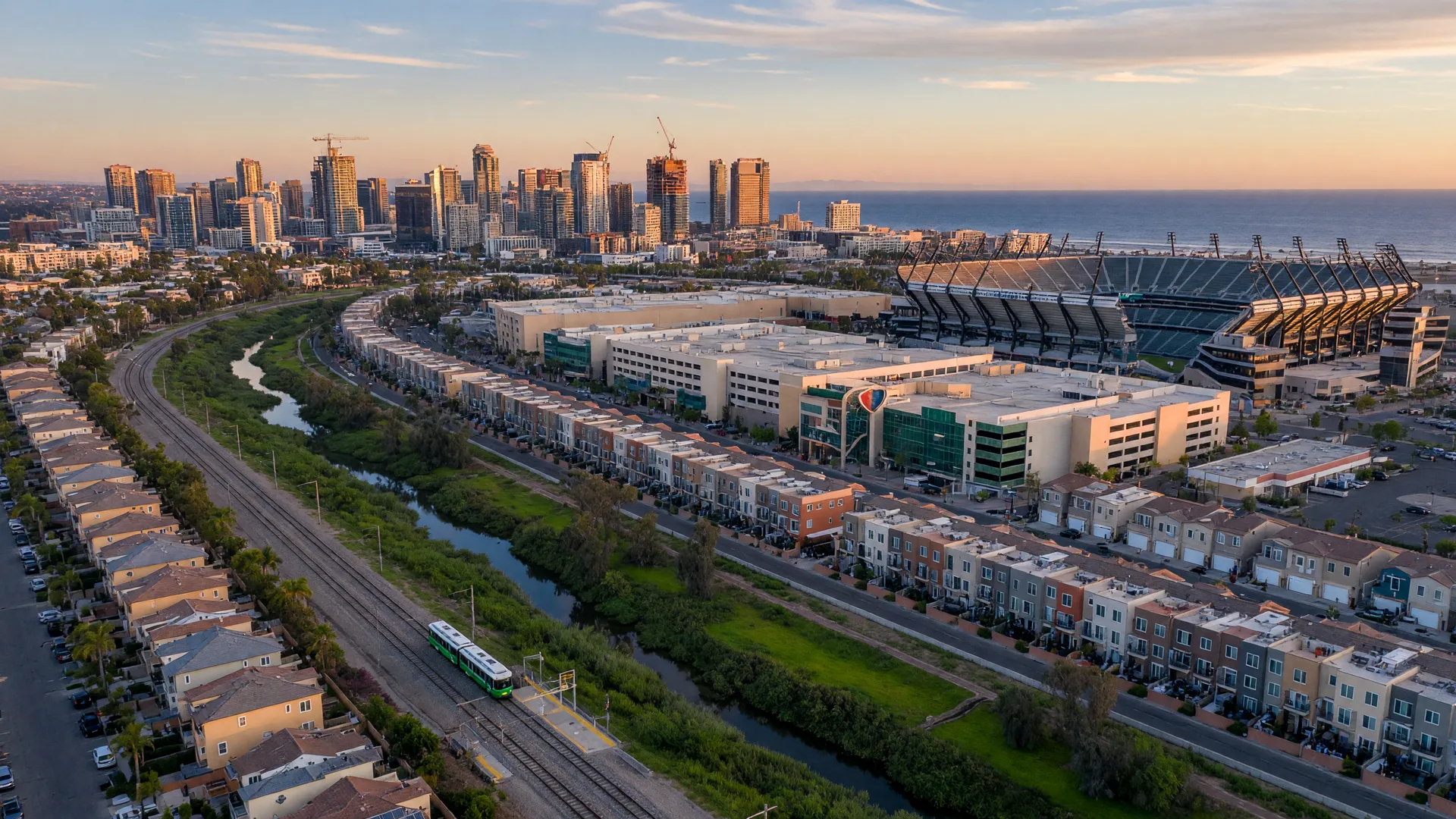
When people think of San Diego neighborhoods, Mission Valley does not always make the top of the list. It is not a beach town. It does not have the historic charm of La Mesa or the prestige address of Del Mar. But here is what Mission Valley has that very few neighborhoods in this city can match: a central location, trolley access, a median price well below the county average, and a transformation underway that is going to reshape what this valley becomes over the next decade. For buyers, sellers, and investors paying attention, Mission Valley is one of the most strategically interesting neighborhoods in San Diego right now.
After 18+ years working in San Diego real estate — as an agent, investor, and military spouse who has watched neighborhoods evolve in real time — I want to walk you through why Mission Valley deserves a closer look. Whether you are a first-time buyer trying to get into the market, a military family looking for a convenient home base, or an investor eyeing long-term upside, this neighborhood has something worth understanding.
Where Mission Valley Sits — and Why It Matters
Mission Valley runs along the San Diego River corridor, roughly between I-8 and I-805, just east of Old Town and northwest of Downtown. It is less than five miles from the coast and under ten minutes from Downtown San Diego by car. That geographic centrality is its defining advantage. You can reach almost every part of the metro area — La Jolla, Kearny Mesa, Point Loma, Chula Vista, and the airport — in 15 to 25 minutes without crossing the county.
For military families, that centrality is even more valuable. MCAS Miramar sits just north of the valley, Naval Base San Diego is a short commute south, and Naval Base Point Loma is reachable in about 15 minutes. Military spouses I work with often tell me they want a home base that puts them close to everything without locking them into a 45-minute commute. Mission Valley delivers on that.
The Green Line Trolley: Mission Valley's Secret Weapon
One of the most underappreciated features of Mission Valley is its direct access to the San Diego Trolley's Green Line. Three stations serve the neighborhood — Fashion Valley, Mission Valley Center, and Grantville — connecting residents to Old Town, Downtown, East County, and SDSU without ever getting on the freeway.
This is not a minor convenience. In a city where traffic on I-8 and SR-163 can turn a 10-minute drive into a 30-minute crawl during rush hour, having a reliable rail option changes the math on daily life. You can ride to a Padres game, commute to Downtown, or get to the airport connection at Old Town station without worrying about parking or traffic. And with SB 79 taking effect this month, the transit-oriented development potential around those trolley stations just increased significantly. Properties within a half-mile of these stops may see heightened developer interest and long-term appreciation as density increases along the corridor.
What You Can Actually Buy in Mission Valley
Mission Valley is primarily a condominium and townhome market. That is important to understand going in, because it shapes both the price point and the lifestyle. The median sale price for condos and townhomes in Mission Valley currently sits in the $580,000 to $650,000 range, depending on the complex and unit size. That is meaningfully below San Diego County's overall median of roughly $925,000 to $950,000 for detached homes.
For first-time buyers, that price gap is significant. A two-bedroom, two-bathroom condo in a well-maintained complex with parking, a pool, and HOA amenities can be attained in the low-to-mid $500,000s. Townhomes with more space, private garages, and sometimes small yard areas trade in the $600,000s to $700,000s. Compared to what you would pay for a single-family home in La Mesa, El Cajon, or Chula Vista, Mission Valley offers a lower entry point with better proximity to employment centers and transit.
The trade-off is that you are living in a shared-wall community with HOA dues, and those dues vary widely — from $350 to over $600 per month depending on the complex, its reserves, and amenities. If you are considering a purchase here, understanding the HOA's financial health, reserve study, and any pending special assessments is critical. I have seen buyers get surprised by $10,000 to $20,000 special assessments after closing because the complex deferred maintenance for years. This is exactly the kind of due diligence I walk my buyer clients through before making an offer.
The Developments Changing Mission Valley's Future
What makes Mission Valley especially compelling right now is the sheer scale of development either under construction or recently completed in and around the valley. These are not small infill projects. They are transformative developments that will add thousands of residents, new retail, new parks, and new infrastructure to an area that is already well-connected.
Riverwalk San Diego
The biggest project in Mission Valley is Riverwalk San Diego, a 200-acre mixed-use development led by Hines along the San Diego River. After securing $380 million in financing in late 2025, construction resumed on this massive project, which includes over 4,300 homes across multiple phases, 200,000 square feet of retail and restaurant space, a riverfront park system, and office space. The first affordable housing component, known as The Becker, is already under construction. When fully built out, Riverwalk will fundamentally change what it means to live in Mission Valley — adding walkable retail, green space along the river, and a sense of place that the valley has historically lacked.
SDSU Mission Valley Campus
San Diego State University's Mission Valley campus expansion is another game-changer. SDSU broke ground on its first affordable housing development at the campus in May 2026, and the AvalonBay Communities residential and retail project is under construction nearby. The campus already includes Snapdragon Stadium, and the surrounding area is being developed with student housing, retail, and community amenities. For property owners in Mission Valley, the presence of a growing university campus with thousands of students, faculty, and staff creates sustained rental demand and long-term neighborhood investment.
ADU and Infill Activity
Beyond the mega-projects, Mission Valley has seen steady ADU and small-scale infill activity. The streamlined ADU permitting under San Diego's 2025 Land Development Code amendments means that properties with room for accessory dwelling units have additional development potential. For investors, this creates opportunities to add rental units on existing lots, particularly in the Grantville subarea where some older single-family properties still exist.
Schools and Family Life
Families considering Mission Valley will find several well-regarded school options. Birney Elementary is rated 10/10 on GreatSchools and holds an A grade on Niche — one of the top-rated elementary schools in the area. Preuss School UCSD, a highly competitive charter school on the UCSD campus, serves grades 6 through 12 and consistently ranks among the best schools in the county. High Tech High and Mt. Everest Academy offer additional alternatives for families seeking project-based or independent study options.
For daily family life, Mission Valley offers more than you might expect. Fashion Valley is one of the largest shopping centers in the region, with major retailers, restaurants, and a movie theater. The San Diego River Trail provides miles of walking and biking paths along the river — a genuine green corridor running through the heart of the valley. Restaurants like ARLO at the Hotel Circle, Lazy Dog Restaurant & Bar, and Wood Ranch at Hazard Center give residents solid dining options without leaving the neighborhood. And for outdoor enthusiasts, the trail system connects to Mission Trails Regional Park, one of the largest urban parks in the country, offering thousands of acres of hiking just minutes from your front door.
What Investors Should Know
Mission Valley is a market that requires careful underwriting. The condo-focused inventory means you are competing with a lot of similar units, and HOA costs eat into cash flow more than they would with a single-family rental. Median rents for a two-bedroom condo in Mission Valley hover around $2,600 to $3,000 per month, and after HOA dues, property taxes, insurance, and maintenance, the margins are tighter than they appear on a spreadsheet.
That said, the long-term case for Mission Valley is strong. The combination of transit access, SDSU campus growth, Riverwalk development, and SB 79 transit-oriented zoning changes all point to sustained demand and potential appreciation. For investors with a 5-to-10-year horizon who can absorb modest cash flow in exchange for equity growth, Mission Valley offers a fundamentally different risk-reward profile than single-family neighborhoods further from the urban core.
If you are evaluating an investment in Mission Valley or anywhere in San Diego, I would love to help you run the numbers. My investment properties page covers how I approach deal analysis, and my Investment Pitfalls guide walks through the most common mistakes I see investors make in this market.
The Honest Assessment: What Mission Valley Is Not
No neighborhood is perfect, and transparency matters more than a sales pitch. Mission Valley has real limitations you should weigh:
- Condo-dominated market. If you want a detached single-family home with a yard, Mission Valley is not the place. You will find that in La Mesa, El Cajon, Santee, or Chula Vista instead.
- HOA complexity. Shared-wall living means shared responsibility. Dues, rules, special assessments, and the quality of HOA management vary enormously between complexes. Due diligence is non-negotiable.
- Flood zone awareness. Parts of Mission Valley sit in FEMA-designated flood zones along the San Diego River. Flood insurance may be required by your lender, and it adds to your monthly cost. Understanding the flood zone map before you buy is essential.
- Freeway noise. Proximity to I-8, I-805, and SR-163 means some units and complexes experience traffic noise. Visiting a property at different times of day — morning commute, midday, and evening — tells you more than any listing description.
The Bottom Line
Mission Valley is not the flashiest neighborhood in San Diego. But it may be the most practical. Central location, trolley access, prices below the county median, major developments adding infrastructure and amenities, and proximity to military bases and employment centers — that is a combination very few neighborhoods can match.
Where are you headed next? If you are a first-time buyer trying to get into the San Diego market, a military family relocating to the area, or an investor looking for a transit-oriented play with long-term upside, Mission Valley deserves a spot on your shortlist. I have walked clients through purchases in this valley for years, and the ones who did their homework on HOAs, flood zones, and complex quality are the ones who found real value.
What is important to you in your next move? Whether it is Mission Valley or another San Diego neighborhood, I would love to help you figure out where you fit. No pressure, no assumptions — just honest guidance and a strategy built around your goals.

Hanna Bederson
Real Estate Agent, Investor & Military Spouse · San Diego · DRE #02096870
Curious about Mission Valley — or another San Diego neighborhood?
Let's Talk StrategyIn service, Hanna